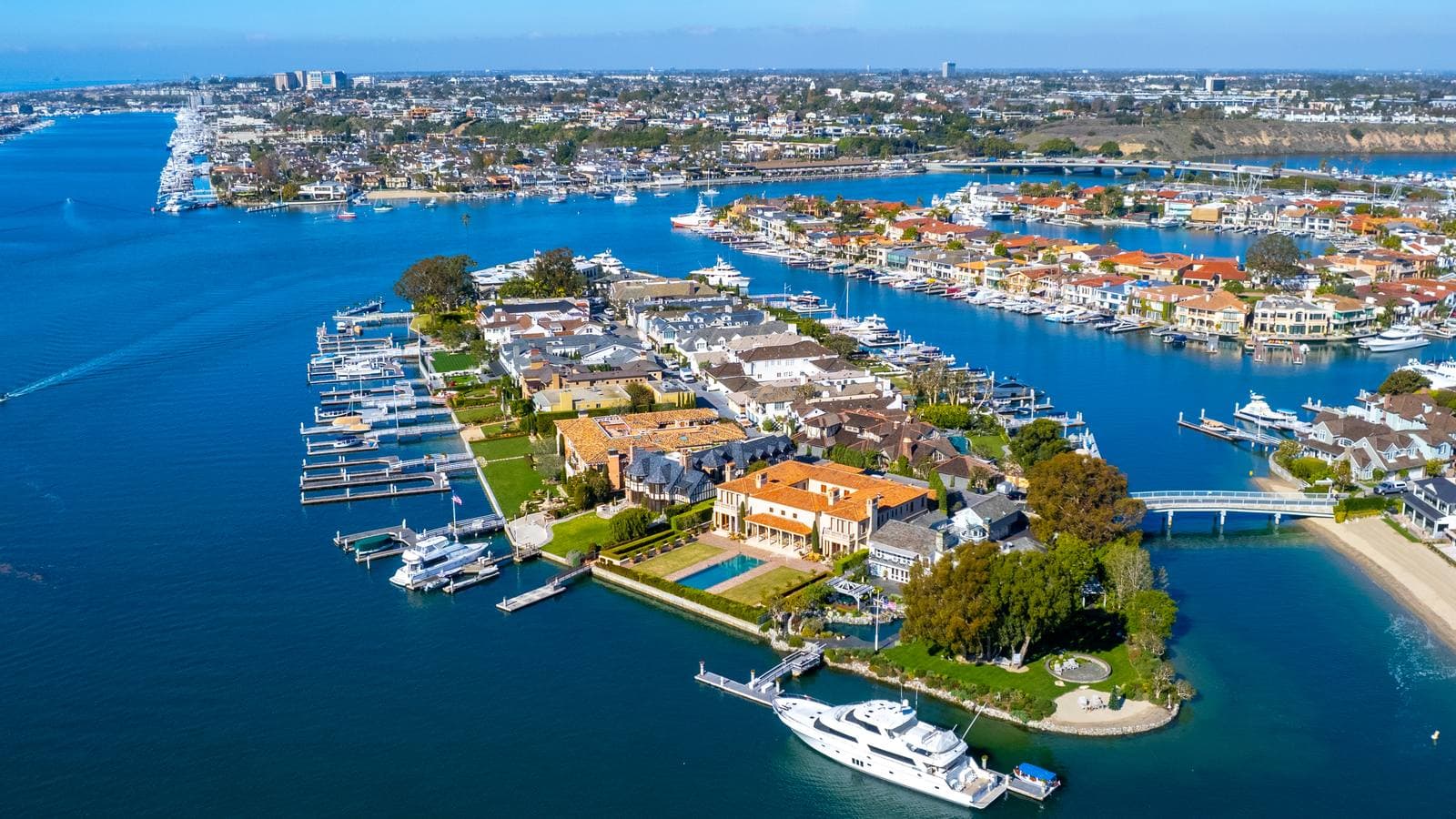
Of all the factors that separate one Newport Harbor property from another, dock rights are the least understood by buyers and the most consequential to value. Two homes can sit on the same street, share a floor plan, and carry the same square footage — and trade in entirely different brackets because of what does or does not happen at the water's edge.
This is also the variable that automated valuation tools handle worst. A national algorithm reads bedrooms, bathrooms, and lot size. It has no field for whether a slip conveys, how long a vessel it holds, or whether the water in front of the house is deep enough to matter.
What "dock rights" actually means
The phrase gets used loosely, and that vagueness costs buyers money. In practice it can describe several genuinely different situations:
- A dock that conveys with the property. The structure exists and transfers to the new owner, subject to the applicable permits and tidelands arrangement.
- A permitted right to build. No dock exists today, but the property carries approval or eligibility to construct one. Value here depends on how firm that approval is.
- A leased slip nearby. Convenient, but a lease is not an appurtenance to the property and may not transfer to you at all.
- Bay frontage with no moorage. The view is there. The ability to keep a boat in front of the house is not.
Those four scenarios can all be described by a listing as "waterfront." They are not the same asset, and they should not be priced as though they were.
Why slip size matters more than slip existence
Once a dock conveys, the next question is capacity. A slip that accommodates a modest craft serves a different buyer than one that holds a substantial vessel, and the pool of buyers who need the larger capacity is smaller, wealthier, and considerably more motivated.
Vessel length is the headline number, but beam and draft matter too — a slip long enough on paper may not work for a wide or deep-hulled boat. Channel depth in front of the property and clearance under any bridge between the slip and open water also constrain what can realistically be kept there. Buyers who own a specific boat should verify all of this against that boat, not against a general description.
The regulatory layer
Docks in Newport Harbor sit within a framework involving city permits and tidelands administration, and structures are subject to inspection and maintenance obligations. A dock that exists physically is not automatically a dock that is fully permitted and in good standing.
This is worth confirming in escrow rather than assuming. Discovering that a structure needs to be brought into compliance after closing is an expensive surprise, and the cost of confirming it beforehand is essentially zero.
How this shows up in pricing
The practical effect is that waterfront pricing in the harbor is not a smooth curve. Homes cluster into tiers defined less by size than by moorage capability, and the gaps between tiers can be substantial. A modest home with excellent dock capacity can outprice a larger home without it.
It also means that comparable sales require care. Two recent sales on the same street are only comparable if their water access is comparable. Running comps on address proximity alone produces confident, wrong numbers — which is exactly how sellers end up mispriced and buyers end up overpaying.
What to do with this
- If you are buying, ask specifically what conveys — in writing, not in conversation.
- Verify permit status and structural condition during your inspection period.
- If you own a boat, confirm the slip works for that boat's length, beam, and draft.
- If you are selling, document your dock rights clearly. Ambiguity costs you money.
Waterfront property in this harbor rewards specificity. The neighborhoods where this matters most are Harbor Island, Lido Isle, Balboa Island, and the bayfront edge of Peninsula Point — each with its own dynamics.
If you are weighing a waterfront purchase or sale and want the specifics on a particular property, reach out directly.
← Back to the Blog