Ask two different data trackers what a home costs on Balboa Island right now and you will get two different answers, and neither one is wrong. Over the three months ending June 2026, the median sale price on the island was $3.8 million, down 18 percent from the same period a year earlier. Pull the single month of May 2026 instead, and the median comes in at $3,798,722, essentially flat, down just 0.034 percent year over year. A separate market analysis pulling from the same MLS feed around the same time put the island's median closer to $4.66 million, up slightly on the year. Meanwhile the median price per square foot for that same three-month window fell 54 percent.
None of these numbers are typos, and none of them are lies. They are what happens when a market this small gets asked to produce a headline statistic every month.
Eleven Sales Is Not a Sample, It's a Coin Flip
Balboa Island sold 11 homes in June 2026, up from 6 the same month a year earlier. That is the entire dataset behind the month's median. Compare that to a mainland Newport Beach tract with hundreds of comparable homes trading every quarter, where a handful of outlier sales gets smoothed out by volume. On an island with a handful of closings, one atypical sale does not get smoothed out. It becomes the median.
Look again at the math behind that median price and median price-per-square-foot moving in wildly different directions. If the median sale price fell 18 percent while the median price per square foot fell 54 percent, the arithmetic only works one way: the homes that happened to close this spring were, on average, considerably larger than the ones that closed the spring before. That is not the market losing value and it is not the market gaining value. It is eleven transactions telling you which specific houses sold, not what the neighborhood is worth.
The mix problem gets worse when you remember that "Balboa Island" as a category blends property types with very different price points. Condos on the island run closer to $1.5 million while single-family homes average $5.5 million, according to the same market analysis cited above. Sell two extra condos in a given month and the blended median drops hard without a single home actually losing value. Sell one extra bayfront estate and the opposite happens. A market this thin does not average out noise. It reports it.
Then there is Little Balboa Island, the quieter half of the island connected to the shop-lined Big Island by a small bridge. In February 2026, Redfin's tracker for that sub-market showed a median sale price of $5.8 million, up 94.6 percent from the year before. Read on its own, that headline suggests a neighborhood exploding in value. Read next to the wider island's flat-to-down numbers from the same season, it reads more like what it actually is: a handful of large or small sales landing in a market too small to absorb them without distortion.
What Actually Holds Value When the Headline Number Doesn't
If the median price is this noisy month to month, the more useful question for a buyer comparing Balboa Island to other Newport Beach neighborhoods is not "what's the median right now" but "what specifically makes one house on this island worth more than another." Three things do most of that work, and none of them show up cleanly in a portal's headline stat.
Lot width. A standard interior lot on Balboa Island runs 30 feet by 85 feet, a dimension you will see repeated across listings for both residential cottages and the occasional mixed-use building near the ferry landing. A 40-foot-wide lot is genuinely rare, and listings treat it that way. One recent listing for a mid-century home on the island marketed its 40-foot lot specifically for the extra width, noting the room it created for private parking and natural light that a standard 30-foot lot simply does not have. Ten extra feet of frontage does more for resale value on this island than the same ten feet would on a typical suburban lot, because it solves a problem almost every other buyer on the island still has.
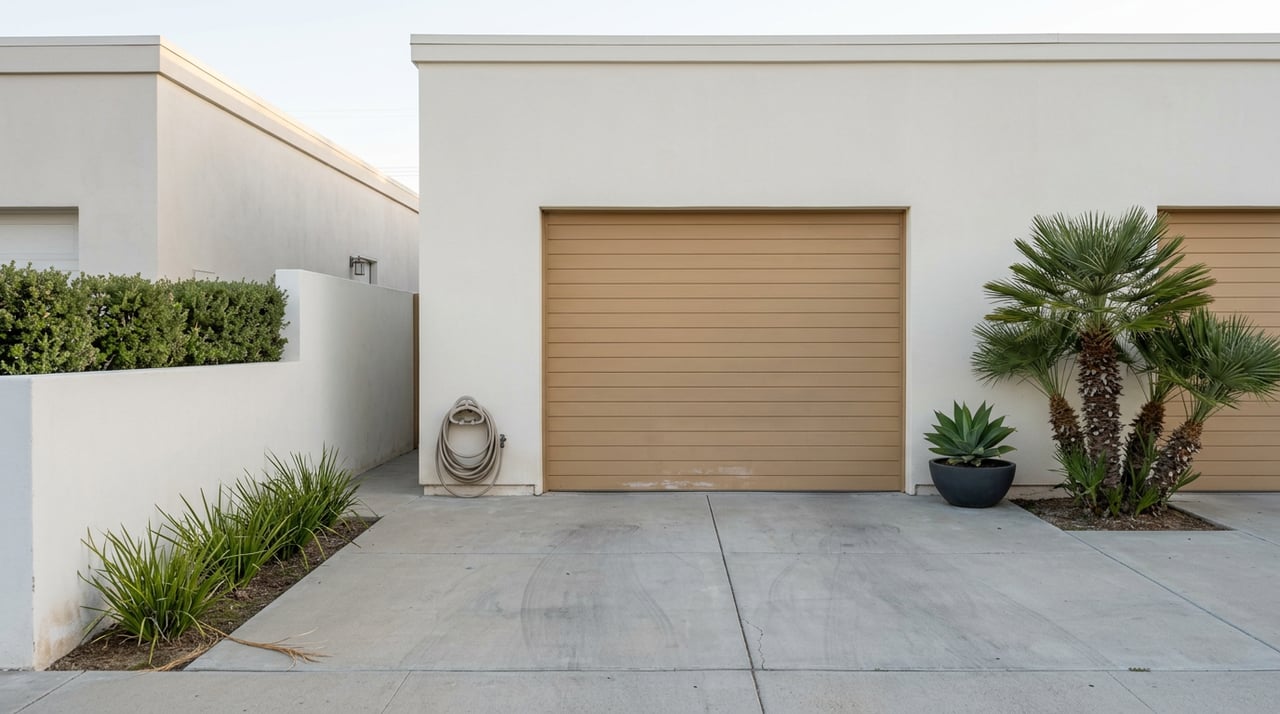
Parking, treated as a feature line item. That problem is parking. Most cottages on Balboa Island back straight onto narrow lot lines with no driveway and no off-street parking at all, which is why a golf cart garage shows up in marketing copy as its own selling point rather than a footnote. One recent bayfront listing described its two-car garage as also fitting a golf cart and called that combination "an exceptional amenity on Balboa Island." When storage space for a golf cart gets its own sentence in the listing description, that tells you how scarce parking capacity actually is, and how much buyers are willing to pay to solve it.
Which side of the bridge you're on. The island is really two markets wearing one name. The larger half hosts Marine Avenue's shops, cafes, and the historic commercial strip, and carries the foot traffic and energy that comes with it. The smaller half, Little Balboa Island, is quieter and more residential, connected to the main island by a small bridge. Buyers who want to walk to dinner and buyers who want distance from foot traffic are often shopping two genuinely different lifestyles under a single neighborhood label, which is part of why blending their sales into one median produces such an unstable number.
How to Use This If You're Comparing Neighborhoods
If you are cross-shopping Balboa Island against Corona del Mar, the Balboa Peninsula, or a mainland Newport Beach neighborhood with deeper inventory, the headline median you find on a search portal is the least reliable number in the comparison. A neighborhood that closes 40 or 50 homes a quarter can support a median that actually means something. A neighborhood that closes single digits most months cannot, no matter how confidently the percentage change is reported next to it.
What holds up better across a thin market like this one is the specific inventory picture at the moment you're looking: current months of supply, how many homes are actually listed right now, and how quickly recent closings are trading relative to list price. Closings on the island have recently finished at roughly 97 percent of asking price with a limited number of homes on the market at any given time, which points to a market where well-priced, well-positioned properties still move quickly even as the median headline bounces around underneath them. Ask about lot width and parking before you ask about the neighborhood's median. On Balboa Island, those numbers tell you more about what you're actually buying.
FAQ
Is Little Balboa Island really more expensive than the rest of the island? Sometimes, and the honest answer is that a single month's data on either side of the island is too thin to say for certain in either direction. Little Balboa Island's February 2026 median came in well above the wider island's spring numbers, but that comparison is one small sample against another. Treat any single month's median on either side as a data point, not a verdict.
Does a wider lot always mean a proportionally higher price? Not proportionally, but width matters more than raw square footage would suggest because it solves the parking problem that most standard 30-foot lots on the island cannot. A 40-foot lot is valued for what it enables, not just for the extra land.
How many homes actually sell on Balboa Island in a typical year? Recent monthly closings have run in the single digits to low teens, which is why month-to-month price comparisons swing so widely. A buyer or seller relying on any one month's reported median should ask what that month's sample actually looked like before trusting the percentage next to it.
If you're weighing Balboa Island against another Coastal Orange County neighborhood and want a read on the current inventory instead of a headline percentage, Kyle Shutts can walk you through what's actually on the market street by street. Schedule a free consultation and get a clearer picture than the median price alone can give you.