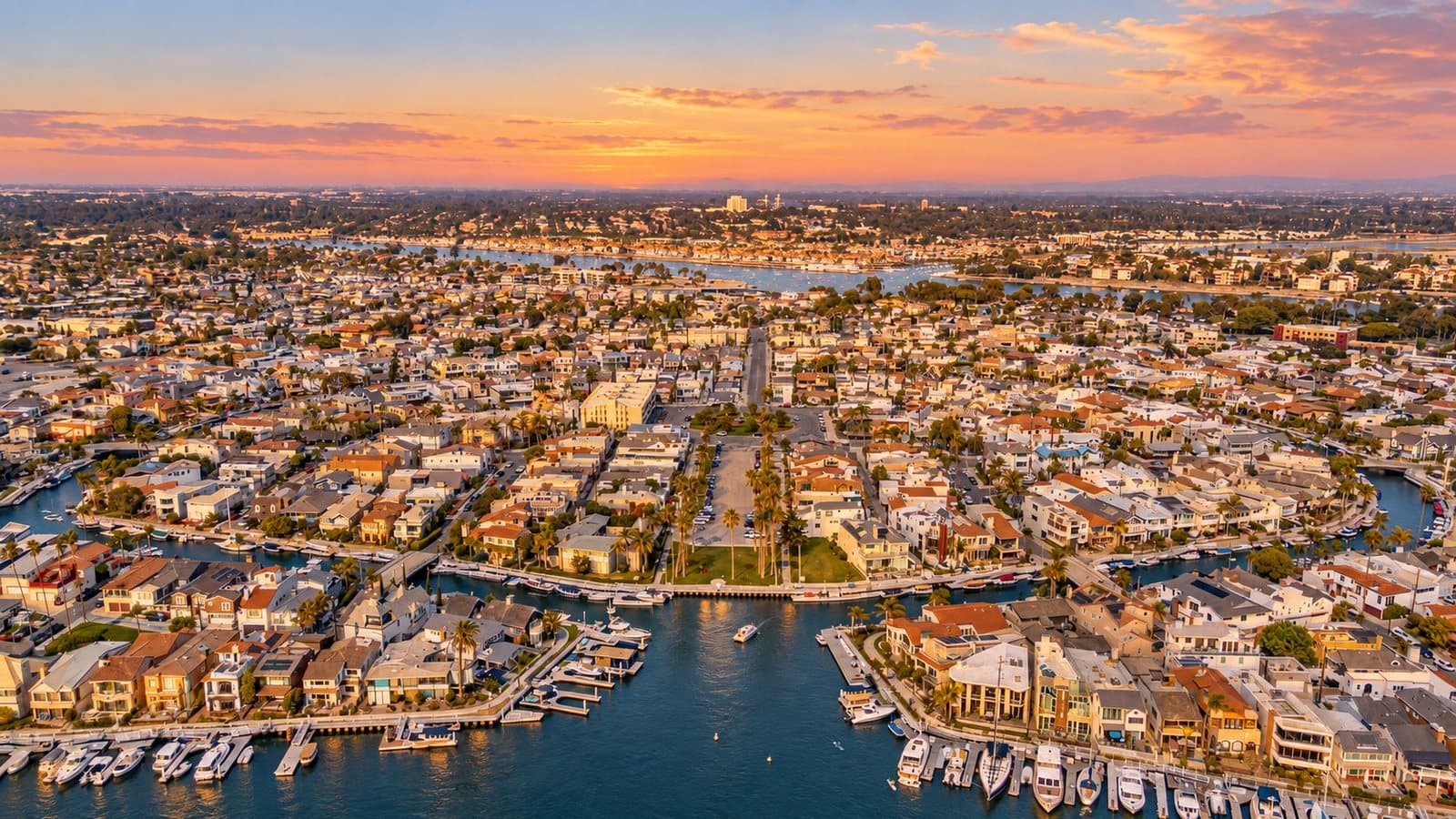
Two houses in El Dorado Park Estates, both built by the same company within a few years of each other, can close in completely different ways. One sails through inspection and funds on schedule. The other stalls two extra weeks while an inspector explains what's actually in the walls and a buyer's lender asks about a soil gas report nobody mentioned at the open house.
Same builder. Same decade. Same neighborhood by every listing description. The difference has almost nothing to do with the year on the county assessor's record.
If you're buying or selling here, the year built is the least useful number on the sheet. Two boundaries that never show up in a listing description do far more to predict your escrow timeline: which side of Wardlow Road the house sits on, and whether it happens to fall inside Long Beach's citywide Methane Zone. Neither one tracks with price. Neither one tracks with square footage. Both show up the moment an inspector or a permit pull gets involved.
One Builder, One Decade, and a Line at Wardlow Road
El Dorado Park Estates exists because one company decided to build there starting in 1962. The developer was S&S Construction, founded by David Shapell, Nathan Shapell, and Max Webb, and this was the first large neighborhood the company ever built before it grew into Shapell Industries. That single-developer, single-decade story is part of why the neighborhood feels so consistent from the street. It's also why buyers assume every home in it carries roughly the same risk profile.
It doesn't split that cleanly. Homes north of Wardlow Road came first, built earlier in the development timeline and smaller, generally running 1,400 to 2,300 square feet. Homes south of Wardlow came later and larger, with some approaching 3,000 square feet, including the tri-level floor plan locals often refer to by its builder model number. Real estate listings in the neighborhood still use that shorthand today, describing a home as a Model 101 or a 201 Model tri-level the same way you'd describe a car trim.
That divide matters for more than square footage. A slightly later construction phase means a slightly later cutoff on which building-code standards and material specifications applied when the slab went in. It's a small gap in years, but on a tract built entirely with 1960s materials and methods, small gaps in years are where the systems variance actually lives.
What "1962" Actually Buys You Underneath the Slab
Here's the assumption worth dropping: that a 1962 build date tells you what's in the walls today. It doesn't. It tells you what was in the walls when the house was framed, and after six decades, that's a starting point, not a current condition report.
Homes from this era across East Long Beach and the El Dorado area were built with galvanized steel supply lines and cast iron or clay sewer laterals as the standard of the time. Galvanized pipe corrodes from the inside out, which means it can choke water pressure years before it visibly leaks. Cast iron and clay laterals crack at the joints and let tree roots in, which is exactly the kind of defect a visual walkthrough won't catch but a sewer camera will.
You can see the era's fingerprint in how these homes get marketed today. Listings in El Dorado Park Estates routinely lead with phrases like "extensive system upgrades including copper plumbing" and "newer PVC sewer line" as selling points, which only works as a selling point if the baseline expectation is the original galvanized and clay. When a listing doesn't mention a repipe or a sewer replacement, that's information too. It means you're likely looking at original-era materials, regardless of what year the model was built or which side of Wardlow it sits on.
This is where the north-south divide actually earns its keep as a negotiating tool. A buyer comparing two houses at the same price point should be asking a very specific question: has this one been repiped, and does the seller have permits to prove it? A permitted repipe or lateral replacement is worth asking about directly, because in a tract this uniform in age, it's one of the few facts that meaningfully separates one listing from another.
The Boundary the Disclosure Form Doesn't Draw
California's Natural Hazard Disclosure Statement is the document most buyers lean on to understand what they're inheriting. It covers six categories: special flood hazard areas, dam inundation zones, very high fire hazard severity zones, wildland fire risk areas, earthquake fault zones, and seismic hazard zones for liquefaction or landslide.
Long Beach's Methane Zone isn't one of them.
Roughly 40 percent of the city sits over the Wilmington Oil Field inside a mapped methane hazard overlay, and construction within that zone, or within 100 feet of an active or abandoned oil well, can trigger mitigation requirements under Chapter 18.79 of the Long Beach Municipal Code. That includes remodels, not just new builds. A kitchen addition or a garage conversion that touches the foundation can require a soil gas investigation and, depending on the results, a passive or active venting system before the city signs off.
None of that shows up on the state disclosure form, because the state form was never built to capture a city-specific overlay. It surfaces instead when someone pulls a building permit application, checks the city's methane zone map directly, or hits it mid-remodel when a contractor asks the city coordinator whether the parcel falls inside the zone. For a buyer planning any structural work in El Dorado Park Estates, checking methane zone status before making an offer is a five-minute step that can save a multi-week surprise later. For a seller, knowing your own status in advance means you're not fielding the question for the first time from a nervous buyer's inspector.
The practical read here isn't that the neighborhood carries some outsized hazard. It's that this specific overlay runs on city geology, not on tract boundaries or build years, so it cuts across El Dorado Park Estates in a way that has nothing to do with which side of Wardlow you're on or how the house is priced.
Before You Write the Offer or List the House
If you're buying, ask for three things before you remove contingencies: the pipe material on the supply lines, a current sewer scope report if one exists, and whether the parcel falls inside the city's mapped Methane Zone. If the seller doesn't have a sewer scope, ordering one during your inspection period is a few hundred dollars that tells you whether you're negotiating from a position of knowledge or guessing.
If you're selling, the same three items work in your favor when you have the paperwork. A permitted repipe with a clean methane zone status turns "1962 tract home" from a liability question into a settled fact, and settled facts move escrows faster than open questions do.
FAQ
Does every home in El Dorado Park Estates have galvanized pipe or a clay sewer lateral?
No. The tract-wide era standard was galvanized supply and cast iron or clay laterals, but many homes have been repiped or had the sewer lateral replaced over the decades. The way to know is a permit history check and, ideally, a sewer camera scope rather than an assumption based on the build year.
If my house isn't in the Methane Zone, do I need to check anything before I remodel?
Long Beach's Building and Safety Bureau determines zone status by parcel, and boundaries can sit closer to a given lot than owners expect. Checking the city's methane zone map before you finalize remodel plans is worth doing regardless of how confident you feel about your location.
Does the Wardlow Road divide affect resale value directly?
Square footage and floor plan drive value more directly than which side of the road a home sits on. The divide matters most as a rough proxy for construction phase and, by transition, which systems are more likely to be original.
← Back to the Blog